Breast screening is asking a new question.
Every year October dresses in pink, and every year we run the risk that the ribbon repeats what it said the year before: get your mammogram. It is a correct and necessary message, but an incomplete one, because in recent months the science of screening has changed its question, and anyone leading a clinic, an insurer or a company in Chile needs to know it before the change arrives by way of facts. In Chile, 2,263 women died of breast cancer in 2023, that is, six every day. The question is no longer just how many mammograms. It is with which eyes, for whom and how often. Three studies, published within less than a year, frame that conversation.
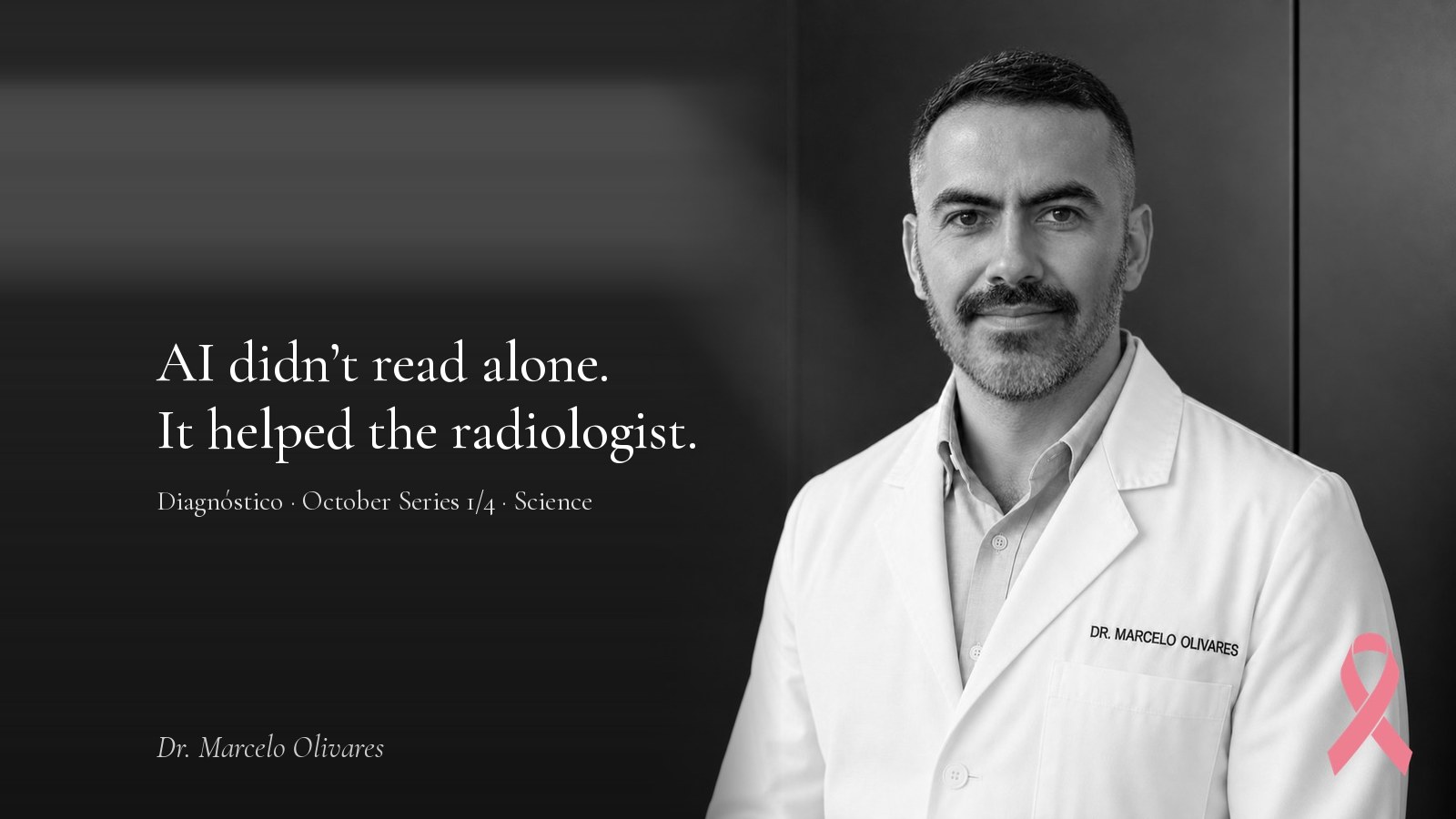
The first is about «with which eyes». The MASAI trial in Sweden randomized more than 105,000 women between traditional double reading by radiologists and AI-supported reading; its final results, published in The Lancet in January, show 12% fewer interval cancers, those that appear between one screening and the next, 27% fewer tumours of aggressive subtypes and a 44% lower reading workload, with similar false positives. In other words, AI did not replace the radiologist… it let the radiologist look better where it mattered.
The second is about «for whom». The WISDOM trial, with more than 28,000 women in the United States, compared annual mammography for everyone with risk-based screening that combines genetics, family history, breast density and lifestyle: the personalized approach was as safe as annual screening and recorded about a third fewer advanced cancers. Age alone is starting to fall short as a criterion.
The third is about «how often», and about the fear that held that question back for years, because the more often we look, the more we fear finding what should not have been found. That fear has a name: overdiagnosis, that is, detecting tumours that would never have caused problems, which some estimates put at 30% or 50%. A meta-analysis published in September in the Journal of the National Cancer Institute reanalysed the eight large randomized trials with their full follow-up and places it below 5%. It does not close the debate, but it brings it back to its proper proportion.
Read together, the three studies sketch a different kind of screening: stratified by risk, assisted by algorithms and measured by what happens in women's lives, not by the volume of tests. For a clinic, that means checking whether its imaging workflow is ready to incorporate AI with local validation and traceability. For an insurer, asking whether its coverage rewards age-based mammography or timely detection according to risk. For a company, understanding that inviting its female employees to get screened is a beginning, not a strategy. For you, the action is concrete: know your family history and, if you have already had a mammogram, ask about your breast density; with that information, talk with your doctor about when and how often to be checked. For your organization, the decision is a different one: stop counting tests and start counting women who reached their diagnosis in time.
The ribbon is still pink. What has changed is the science that holds it up.
Sources: Gommers J, Lång K, et al. MASAI. The Lancet 2026 · Esserman LJ, et al. WISDOM. JAMA 2025 · Njor SH, et al. Overdiagnosis in mammography trials. JNCI 2026 (via News-Medical) · University of Chile, DEIS-MINSAL, breast cancer deaths 2023